
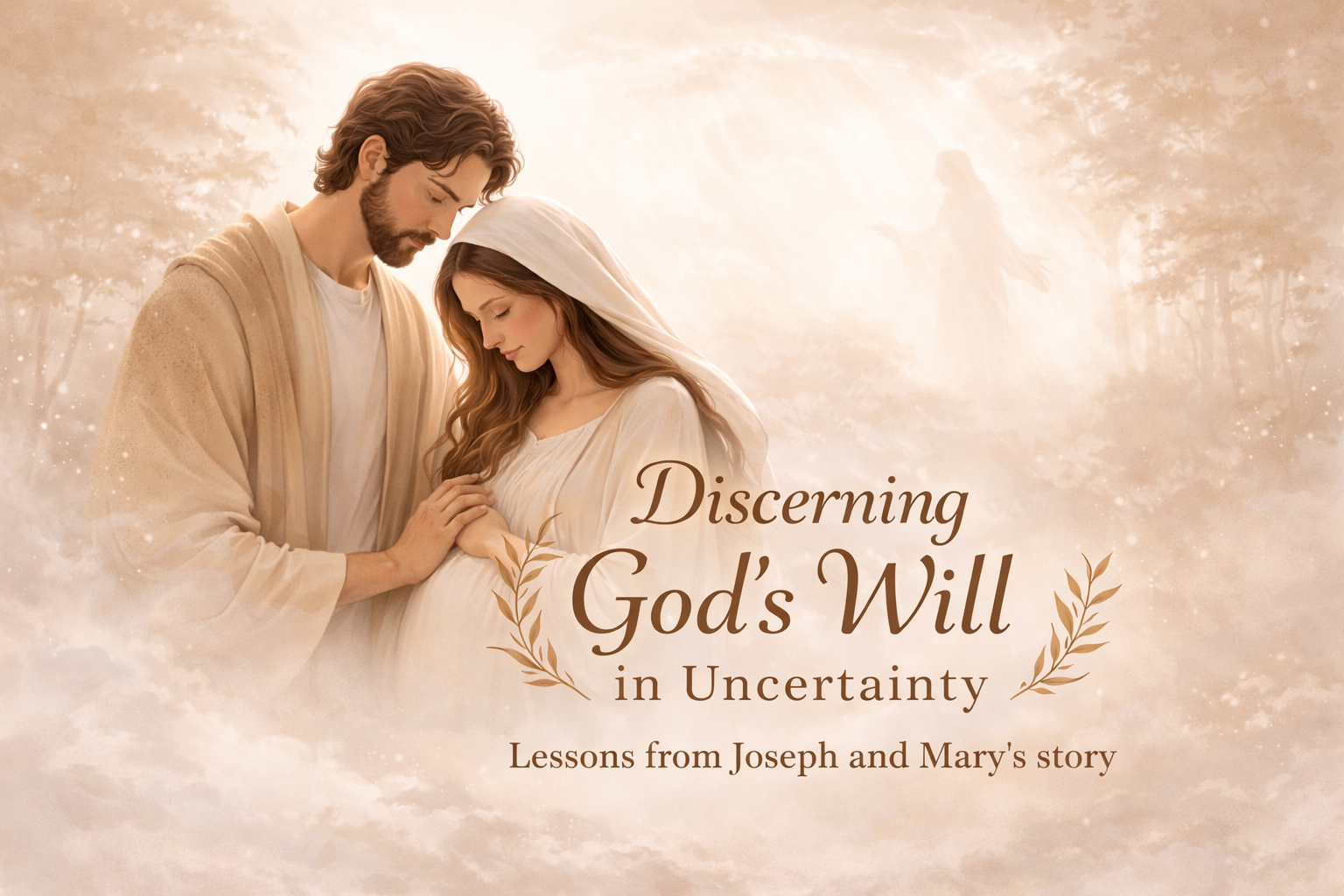
Lessons from Joseph and Mary’s Story
Uncertainty has a way of unsettling the human heart. When things do not make sense, when events appear confusing or even contradictory, our natural instinct is to seek quick explanations, defend our position, or follow what seems culturally and logically right. Yet, Scripture repeatedly shows us that God sometimes works most profoundly in moments that appear unclear to human understanding.
One of the clearest biblical examples of this is found in the story of Joseph and Mary.
Mary’s pregnancy was not only mysterious—it was culturally dangerous. In Jewish society, pregnancy outside of marriage was considered shameful and punishable. Joseph, a righteous man, faced a dilemma that no one would have questioned him for resolving by leaving Mary. In fact, culturally, morally, and socially, Joseph had every justification to walk away. Most voices around him—spoken or unspoken—would have supported that decision.
From a human perspective, the facts were loud: Mary was pregnant, and Joseph was not the father. The situation was unclear, confusing, and seemingly irredeemable. If ever there was a moment where logic and culture spoke strongly, this was it.
Yet Scripture tells us something remarkable: Joseph considered these things (Matthew 1:20). He paused. He did not rush to act on what seemed obvious.
Often, we mistake confusion for God’s absence. We assume that if something is unclear, painful, or socially misunderstood, then God cannot be in it. But the story of Joseph teaches us the opposite. Sometimes, uncertainty is not a sign that God is absent—it is a sign that God is working in a way that transcends human understanding.
Before the angel spoke, Joseph was already choosing silence over impulse. While society was voicing its expectations, Joseph allowed space for God to speak. And it was in that quiet posture that divine clarity came.
This teaches us a powerful truth: God’s will is often revealed not when every detail is clear, but when the heart is willing to listen beyond human noise.
When Man Is Voicing, Can You Be Silent?
In seasons of uncertainty, many voices rise—family opinions, cultural norms, personal fears, and even logical reasoning. These voices are not always wrong, but they are not always final. Joseph’s story challenges us to ask an important question: When man is voicing, can you be silent long enough to find out what God is saying?
Silence before God is not weakness; it is wisdom. It is in stillness that discernment is sharpened. God often speaks in ways that require attentiveness, humility, and patience—qualities that cannot thrive in a noisy heart.
Discerning God’s will amidst uncertainty requires a few intentional postures:
Pause before acting. Like Joseph, resist the urge to make quick decisions based solely on appearances. A pause creates room for divine insight. Choose righteousness over reputation. Joseph valued obedience to God above social approval. God’s will often contradicts what is culturally celebrated. Seek God beyond logic alone. Faith does not discard reason, but it goes beyond it. God’s purposes may not always align with what seems reasonable at first glance. Stay open to divine interruption. Joseph’s clarity came through a dream—unexpected, supernatural, and timely. God still interrupts human plans when hearts are surrendered.
Abraham was asked to leave a familiar land without knowing his destination. Moses was called to deliver Israel despite feeling inadequate. Esther faced a life-threatening decision without certainty of the outcome. In each case, clarity followed obedience, not the other way around.
God’s will often unfolds step by step, not all at once.
The story of Joseph reminds us that uncertainty is not the enemy of faith—it is often the environment in which faith matures. When situations appear undefined and confusing, it may be an invitation to listen more closely to God rather than react to human voices.
In moments where clarity is absent, silence before God becomes a sacred space. And in that space, God speaks—revealing His will not always through immediate answers, but through peace, direction, and trust.
May we learn, like Joseph, to pause when man is voicing, to listen when culture is loud, and to discern God’s will even when the path ahead is unclear.